
September 2026 Municipal Market Comments
Tax-Exempt Yields Rise and Curve Flattens
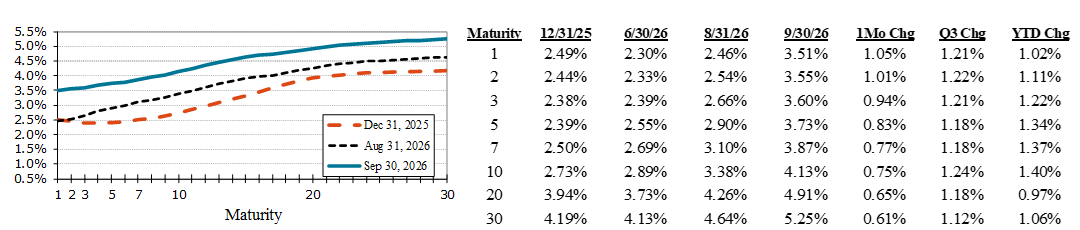
Tax-exempt yields moved sharply higher in the third quarter as the municipal yield curve flattened, with most of the adjustments occurring in September. During the month, the 2yr AAA municipal yield rose 101 bps, while 10yr and 30yr yields increased 75 bps and 61 bps, respectively. Municipal yields responded to the Federal Reserve’s September rate hike and a broader Treasury market selloff driven by persistent inflation concerns, resilient economic data, and geopolitical uncertainty. Higher rates also triggered significant tax-loss harvesting, adding to secondary market trading activity and further pressuring municipal valuations. As a result, municipals underperformed Treasuries during the quarter, causing municipal-to-Treasury yield ratios to cheapen, which improved the relative value of tax-exempt issues. The spread between 2yr (3.55%) and 30yr (5.25%) AAA municipal yields narrowed to 170 bps at quarter-end, down from 210 bps at the end of August. Despite heightened volatility, the higher absolute yields and improved relative value continued to support investor demand. Net inflows to municipal bond funds totaled approximately $7.9B in September and a strong $24.9B for the quarter, lifting YTD inflows to roughly $74.9B. Meanwhile, September tax-exempt issuance reached a record $53B, up 17% from a year ago, bringing YTD issuance to $434B, 8% ahead of last year’s record pace. The combination of rising yields and municipal underperformance pushed taxable-equivalent yields to attractive levels not seen in decades, with some high-tax-state investors able to achieve double-digit taxable-equivalent yields.
AAA Municipal Yields
Challenges for Local School Districts
Local school districts face a growing convergence of financial and operational pressures that are beginning to affect credit quality, albeit from a strong starting position. A combination of declining enrollment, rising labor and operating costs, the end of federal pandemic aid, and policy changes at the state level is creating a more challenging environment for many K-12 issuers. Enrollment declines are particularly problematic as funding is often tied to enrollment, while fixed costs associated with existing facilities, staffing, and debt obligations remain. These challenges are likely to intensify as the education sector continues to see weakening demographics, with lower birth rates expected to reduce the school-age population across many regions over the coming decade. At the same time, many states are pursuing property tax relief measures in an effort to address affordability concerns. Rating agencies have already begun to respond. In Iowa, S&P recently downgraded 27 school districts as a portion of the school-related sales tax revenues is redirected for property tax relief. In Texas, property tax relief initiatives are expected to constrain revenue growth for schools and local governments, while Florida districts are confronting both declining public-school enrollment and growing participation in voucher and school choice programs. As a result, many districts are facing difficult decisions regarding staffing levels, facility utilization, and future capital spending. Nevertheless, the sector remains fundamentally strong, with most local school districts carrying ratings in the A and AA categories, reflecting the essential nature of public education, broad taxpayer support, and generally sound financial management.
Negative Returns in Q3
Returns were negative in September and for the quarter as yields rose across the curve. Shorter maturities outperformed longer maturities given their lower duration, which also benefited Prerefunded issues over GO and Revenue issues. By quality, issues rated AA led performance among Investment Grade issues, while High Yield outperformed Investment Grade.
Total Returns of Selected Bloomberg Municipal Indices and Subsectors

Disclosures
Information in this document regarding market or economic trends, or the factors influencing historical or future performance, reflects the opinions of management as of the date of this document. These statements should not be relied upon for any other purpose. This is not a complete analysis of every material fact regarding any company, industry, or security. The information has been obtained from sources we consider to be reliable, but we cannot guarantee the accuracy. Past performance is no guarantee of future results. Indices are unmanaged and are not available for direct investment.
Fixed income is generally considered to be a more conservative investment than stocks, but bonds and other fixed income investments still carry a variety of risks such as interest rate risk, credit risk, inflation risk, and liquidity risk. In a rising interest rate environment, the value of fixed-income securities generally decline and conversely, in a falling interest rate environment, the value of fixed-income securities generally increase. High yield securities may be subject to heightened market, interest rate or credit risk and should not be purchased solely because of the stated yield.
The Bloomberg Municipal Bond Index is a broad-based, total-return index. The bonds are all investment-grade, tax-exempt, and fixed-rate securities with long-term maturities (greater than 2 years). They are selected from issues larger than $50 million. The components listed below the Municipal Bond Index (long maturities, intermediate maturities, short maturities, prefunded bonds, general obligation bonds and revenue bonds) are subsectors of the Bloomberg Municipal Bond Index and do not represent separate indices.
The Bloomberg High Yield Municipal Index includes bonds with a par value of at least $3 million and must be issued as part of a transaction of at least $20 million. The maximum rating for inclusion is Ba1/BB+/BB+ using the middle rating.
For more information about the Bloomberg Municipal Bond Index or Bloomberg High Yield Municipal Index, please visit https://www.bloomberg.com/professional/products/indices/documentation/?currentPage=1
Municipal securities investments are not appropriate for all investors, especially those taxed at lower rates. The alternative minimum tax (AMT) may be applicable, even for securities identified as tax exempt. Past performance is not a guarantee of future results.
Ratings are measured on a scale that ranges from AAA or Aaa (highest) to D or C (lowest). Investment grade investments are those rated from highest down to BBB- or Baa3.
©2026 Robert W. Baird & Co. Incorporated.