
October 2026 Municipal Market Comments
Tax-Exempt Yields Fall in October
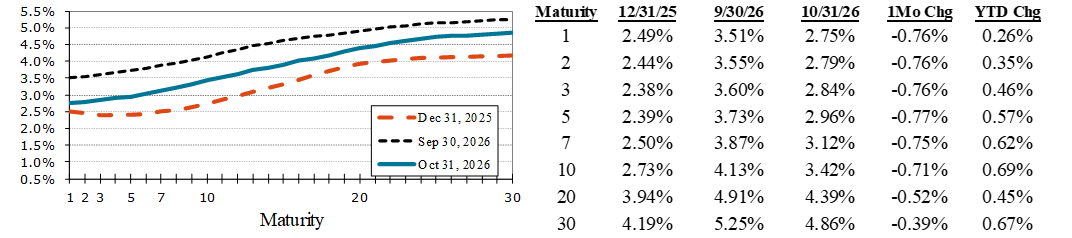
Tax-exempt yields fell sharply in October, reversing nearly all of September’s increase, while the curve steepened following the prior month’s flattening. The 2yr AAA municipal yield declined 76 bps during the month, compared with declines of 71 bps and 39 bps in the 10yr and 30yr yields, respectively. The spread between 2yr (2.79%) and 30yr (4.86%) AAA yields widened back to 207 bps, just below its 2026 peak of 216 bps in March. Municipals benefited from a broader Treasury rally as expectations for near-term Fed tightening moderated and concerns surrounding AI-related valuations and capital spending contributed to a risk-off move. Supply/demand technicals improved as new issuance came in lighter than expected. Higher yields entering October continued to encourage tax-loss harvesting, driving elevated secondary market trading activity, though demand remained healthy. Municipal bond funds and ETFs recorded approximately $4.1B of net inflows during the month, bringing YTD inflows to roughly $79B. Meanwhile, October tax-exempt issuance totaled $46B, down 11% from a year ago, as the higher-rate environment entering the month contributed to a slower new-issue calendar. Even so, YTD tax-exempt issuance of $480B remains 6% ahead of last year’s record pace. With the midterm elections and holiday season approaching, the new-issue calendar is expected to moderate further, potentially providing a more supportive technical backdrop if demand remains firm.
AAA Municipal Yields
Meeting Long-Term Community Needs
With the midterm elections approaching, fiscal priorities at the state and local level are likely to receive increased attention. While much of that discussion centers on spending and taxes, municipal borrowing plays an important role in addressing longer-term needs that cannot always be accommodated through annual budgets. The benefits of that investment can be very tangible: housing bonds can expand the supply of affordable homes, utility financings can lower the cost of providing electricity to customers, and investments in water, flood control, and other resilient infrastructure can better prepare communities for natural disasters while reducing the potential economic and financial costs of future events. Healthcare facilities, schools, and transportation systems similarly provide essential services whose benefits can extend well beyond the year in which the investment is made. Bonds allow governments and other public-purpose entities to spread the cost of these long-lived projects across the generations that will benefit from them. Yet these needs are growing at a time when public borrowing has lagged the broader economy. A recent report from Municipal Market Analytics found that in inflation-adjusted terms, municipal debt outstanding has declined roughly 30% since 2011, while municipal debt as a percentage of personal income has fallen 33% nationally since 2013. At the same time, estimates of deferred maintenance on public infrastructure alone run into the trillions of dollars. These figures highlight a balance facing state and local governments. Additional borrowing creates future fixed obligations, but delaying investment can carry significant consequences as infrastructure ages and projects become more expensive to address. Striking the right balance is particularly important as communities confront needs ranging from housing affordability and energy costs to aging infrastructure and greater exposure to natural disasters.
Positive Returns in October
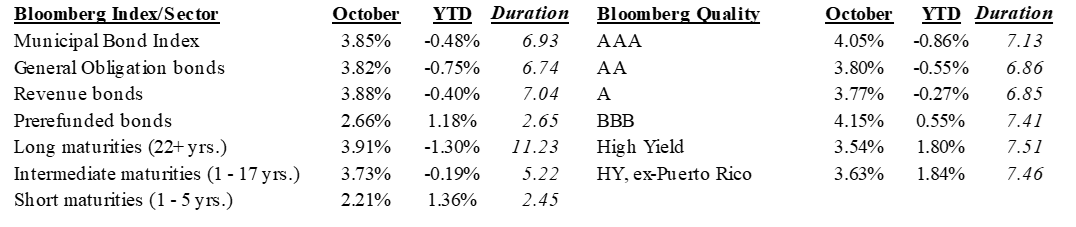
Municipal returns were positive in October as yields declined across the curve, with longer maturities outperforming shorter maturities. Revenue bonds performed in line with GO issues, while Prerefunded bonds trailed for the month. Across credit quality, bonds rated BBB posted the strongest returns, while Investment Grade municipals outperformed High Yield.
Total Returns of Selected Bloomberg Municipal Indices and Subsectors
Disclosures
Information in this document regarding market or economic trends, or the factors influencing historical or future performance, reflects the opinions of management as of the date of this document. These statements should not be relied upon for any other purpose. This is not a complete analysis of every material fact regarding any company, industry, or security. The information has been obtained from sources we consider to be reliable, but we cannot guarantee the accuracy. Past performance is no guarantee of future results. Indices are unmanaged and are not available for direct investment.
Fixed income is generally considered to be a more conservative investment than stocks, but bonds and other fixed income investments still carry a variety of risks such as interest rate risk, credit risk, inflation risk, and liquidity risk. In a rising interest rate environment, the value of fixed-income securities generally decline and conversely, in a falling interest rate environment, the value of fixed-income securities generally increase. High yield securities may be subject to heightened market, interest rate or credit risk and should not be purchased solely because of the stated yield.
The Bloomberg Municipal Bond Index is a broad-based, total-return index. The bonds are all investment-grade, tax-exempt, and fixed-rate securities with long-term maturities (greater than 2 years). They are selected from issues larger than $50 million. The components listed below the Municipal Bond Index (long maturities, intermediate maturities, short maturities, prefunded bonds, general obligation bonds and revenue bonds) are subsectors of the Bloomberg Municipal Bond Index and do not represent separate indices.
The Bloomberg High Yield Municipal Index includes bonds with a par value of at least $3 million and must be issued as part of a transaction of at least $20 million. The maximum rating for inclusion is Ba1/BB+/BB+ using the middle rating.
For more information about the Bloomberg Municipal Bond Index or Bloomberg High Yield Municipal Index, please visit https://www.bloomberg.com/professional/products/indices/documentation/?currentPage=1
Municipal securities investments are not appropriate for all investors, especially those taxed at lower rates. The alternative minimum tax (AMT) may be applicable, even for securities identified as tax exempt. Past performance is not a guarantee of future results.
Ratings are measured on a scale that ranges from AAA or Aaa (highest) to D or C (lowest). Investment grade investments are those rated from highest down to BBB- or Baa3.
©2026 Robert W. Baird & Co. Incorporated.